Alumina Ceramics
Aluminum oxide ceramics are ideal for plant components with extreme wear and/or temperature loads, where a thin lining or a particularly smooth surface is required.
When using aluminum oxide as high-quality wear protection, you should work with an Al2O3 content of at least 92%. Higher aluminum oxide proportions in the ceramic of up to 98% increase the ceramic hardness and wear resistance of the ceramic.
Due to the excellent properties in terms of wear protection, corrosion and heat resistance, these aluminum oxide ceramics are preferably used in material handling in the cement and coal industries, in the electricity, metallurgy, mining and chemical industries.
- Hardness:The hardness of Al2O3 is far higher than that of wear resistant steel (Hardox, etc.) or other common anti-wear materials such as cast basalt. (Moh´s Hardness approx. Grade 9, Rockwell Hardness appox. 87, Vicker´s Hardness approx. 1.200 kg/mm2 )2O3 .
- Abrasion resistance: The abrasion resistance of AI2O3 is about 260 to 270 times that of manganese steel and about 170 times that of wear-resistant chromium steel. Lining pipes with Al2O3 increases the service life of pipes by at least ten times under the same operating conditions.2O3 .
- Corrosion Resistance: High Al2O3 ceramics have an extremely stable molecular structure and are resistant to electrochemical corrosion. This ensures high corrosion resistance to various solutions such as acid, alkali, salt and organic solvents.2O3 is about 260 to 270 times that of manganese steel and about 170 times that of wear-resistant chromium steel. Lining pipes with Al2O3 increases the service life of pipes by at least ten times under the same operating conditions.
- Self-lubrication: Ceramics with a high Al2O3 Al2O3 content have excellent self-lubrication properties and are non-sticky. The roughness of the ceramic is only 1/6 that of steel pipes, resulting in less flow resistance. Compared to steel pipes, when using Al2O3, it is possible to reduce the inner diameter of the pipe by about 15.4% without increasing the flow resistance in the pipe.2O3.
- Weight: The density of alumina ceramics of 3.6g/cm3 is only 50% of steel weight, which can greatly reduce the weight of piping systems.
- Maintenance: Longer maintenance intervals reduce material and, above all, labor costs.
Areas of application
- Wear- and tear- protection, for all conveyed goods
- Operating temperature of up to 1.550 °C
- E.g.: pipelines, flotation, channels, slides, cyclone separators, containers, apparatus, bunkers.
Forms of delivery
- Standard plates, lengths 150 – 250 mm,
- Wall thicknesses 6 - 50 mm, with/without hole/threaded bolt
- Square plates 10 x 10mm and 20 x 20mm and 25 x 25mm, available with thicknesses from 3mm to 10mm.
- Hexagonal plates SW 20 and SW 32, available with thicknesses from 3mm to 25mm
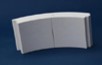
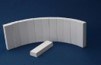
- Ceramic segments for straight pipes and pipe bends can be supplied in various wall thicknesses and inside diameters.
- Production on customer’s request
Types of fastening
- Bonding with epoxy adhesive systems (temperature resistance up to 120°C)
- Bonding with epoxy adhesive systems (temperature resistance up to 300°C)
- Screening
- Welding
- Hardness:The hardness of Al2O3 is far higher than that of wear resistant steel (Hardox, etc.) or other common anti-wear materials such as cast basalt. (Moh´s Hardness approx. Grade 9, Rockwell Hardness appox. 87, Vicker´s Hardness approx. 1.200 kg/mm2 )2O3 .
- Abrasion resistance: The abrasion resistance of AI2O3 is about 260 to 270 times that of manganese steel and about 170 times that of wear-resistant chromium steel. Lining pipes with Al2O3 increases the service life of pipes by at least ten times under the same operating conditions.2O3 .
- Corrosion Resistance: High Al2O3 ceramics have an extremely stable molecular structure and are resistant to electrochemical corrosion. This ensures high corrosion resistance to various solutions such as acid, alkali, salt and organic solvents.2O3 is about 260 to 270 times that of manganese steel and about 170 times that of wear-resistant chromium steel. Lining pipes with Al2O3 increases the service life of pipes by at least ten times under the same operating conditions.
- Self-lubrication: Ceramics with a high Al2O3 Al2O3 content have excellent self-lubrication properties and are non-sticky. The roughness of the ceramic is only 1/6 that of steel pipes, resulting in less flow resistance. Compared to steel pipes, when using Al2O3, it is possible to reduce the inner diameter of the pipe by about 15.4% without increasing the flow resistance in the pipe.2O3.
- Weight: The density of alumina ceramics of 3.6g/cm3 is only 50% of steel weight, which can greatly reduce the weight of piping systems.
- Maintenance: Longer maintenance intervals reduce material and, above all, labor costs.